I did not come back for the cake.
I did not come back for the champagne, the white roses, or the soft string music drifting under the chandeliers.
I came back because after nine years of silence, I wanted to know whether my family had changed.
I wanted to know whether distance had done what love never had.
It hadn’t.
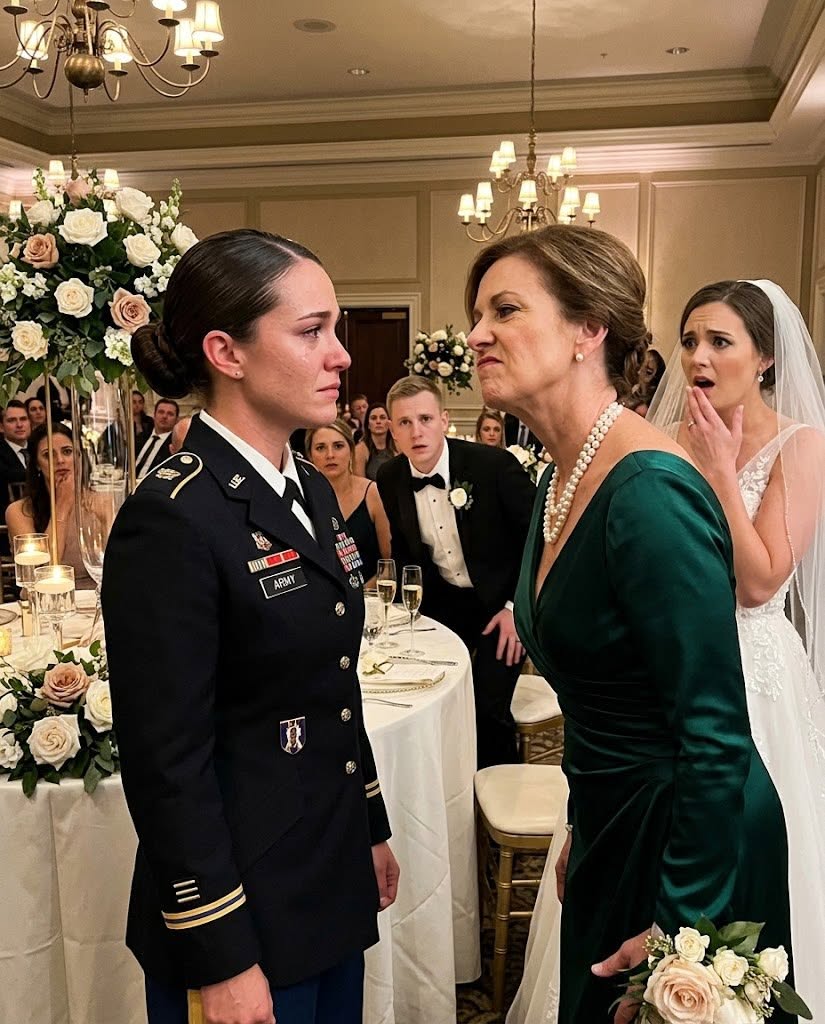
My mother saw me the moment I stepped into the ballroom.
Her eyes traveled over my dress uniform, the ribbons on my chest, the polished shoes, the neat bun at the nape of my neck.
She smiled the same smile she used when she was about to say something cruel and make it sound elegant.
“What is a lowly soldier like you doing back here?” she asked.
The line landed exactly the way she wanted it to.
A few guests let out strained little laughs.
Not because it was funny, but because people often laugh when they sense power being used and do not want to be on the wrong side of it.
My father dropped his gaze to his drink.
My younger sister Ellie, glowing in white satin beside the sweetheart table, froze with a horrified smile on her face.
She knew that tone.
She had heard it her whole life.
The difference was that it had never been aimed at her.
And then there was Daniel.
Daniel did not laugh.
He went white.
His hand tightened around his glass until his knuckles changed color.
He stared at me so hard that for one strange second, I felt as though the room had tilted.
He was not seeing a stranger in a uniform.
He was seeing a memory.
To understand why, you have to go back to when I was eighteen, sitting at my parents’ kitchen table with my college acceptance letter in one hand and a tuition statement in the other.
My mother was peeling a clementine.
That detail has never left me.
The small neat spiral of orange skin falling onto the cutting board while my future sat in front of her, unpaid and unwanted.
“You’ll figure it out,” she said when I asked if they could help.
I looked at my father, waiting for him to do what fathers in other families seemed to do in stories—clear his throat, open a spreadsheet, say they would make sacrifices, say they would at least try.
Instead he barely glanced up from his laptop.
“Your mother is right,” he said.
It was such a small sentence for something that changed the shape of my life.
A week later Ellie came home upset because her car made her look cheap in front of her friends.
By Friday, there was a newer one in the driveway.
My mother handed her the keys with both hands, smiling like she was presenting a tiara.
My father stood there proud and satisfied.
Ellie cried, hugged them, and promised she loved them more than anyone.
I stood in the doorway looking at the tuition bill still sitting on the counter.
That was when I learned the truth about my family.
They never had to say who mattered more.
They expressed it in purchases, in rescue, in generosity that flowed in one direction.
I tried anyway.
I enrolled.
I worked every shift I could get.