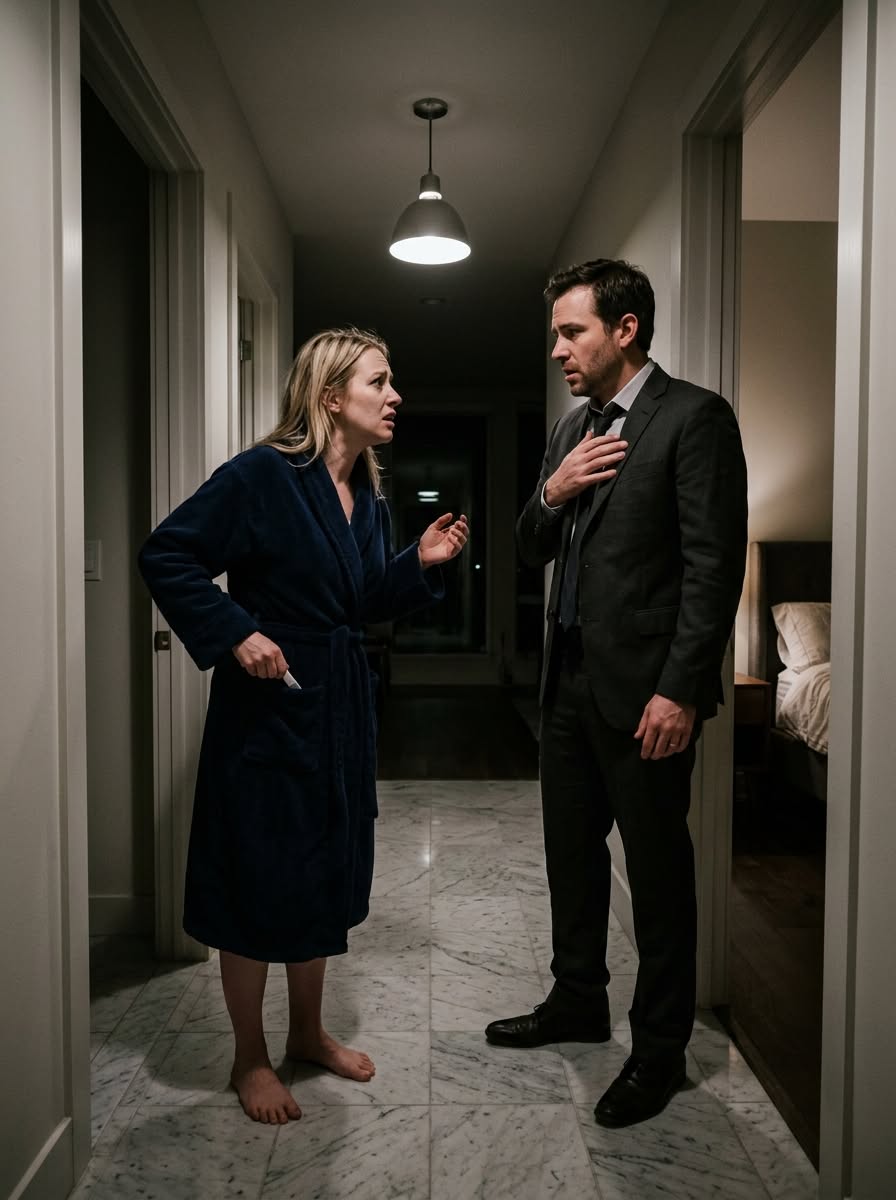
The first lie split open before the second pink line had even finished darkening.
Eleanor Hayes stood barefoot on the marble floor of the upstairs bathroom, one hand gripping the edge of the sink, the other holding a pregnancy test she had taken in secret because hope had become too humiliating to share.
For four years, she and Grant Mercer had lived inside a marriage crowded by absence.
Absence in the room that had once been painted for a nursery.
Absence in the quiet after fertility appointments.
Absence in the way Grant no longer brushed her shoulder when he passed behind her in the kitchen, as if disappointment had made touch dangerous.
But now there it was.
Pregnant.
Not almost.
Not maybe.
Not another cruel misunderstanding from her own body.
Pregnant.
Eleanor pressed her palm over her mouth and stared at her reflection.
Thirty-three years old.
Tired eyes.
Damp hair pinned loosely at the nape of her neck.
A woman who had spent too many nights pretending not to hear her husband sigh when another month failed them.
Then she laughed.
It was not graceful.
It burst out of her like a sob wearing joy.
‘Grant,’ she whispered.
She imagined running downstairs, imagined his face changing from surprise to relief.
Once, long before Mercer Urban Group became one of Boston’s rising development firms, Grant had looked at her as though she were the best thing he had ever built his life around.
Back then he thanked her for every investor dinner she attended, every proposal she polished, every design suggestion that made his presentations stronger.
They were partners in everything, or so she had believed.
They had wanted this baby once.
Before wanting turned sour.
Eleanor slipped the test into the pocket of her robe and opened the bathroom door.
The hallway was dark.
Too dark.
No television murmured from Grant’s study.
No clink of ice in a glass came from downstairs.
Their modern house, usually glowing like a magazine spread, felt suspended in a silence so complete it seemed to be holding its breath.
‘Grant?’ she called.
No answer.
A quick pulse of fear sent her toward the stairs.
For one brief second, she thought something might be wrong.
That he was ill.
That he had received terrible news.
That whatever waited below would require tenderness, and despite everything, she was still ready to give it.
Then she heard his voice.
‘No, Vanessa.
I’m telling her tonight.’
Eleanor stopped halfway down the staircase.
Vanessa Cole.
Grant’s communications director.
Thirty.
Elegant.
Sharper than anyone in the room and aware of it.
Eleanor had once admired her.
She had defended Vanessa in rooms full of men who mistook female intelligence for aggression.
Now she stood in the dark with a pregnancy test hidden against her hip and listened to her husband use a voice he had not used with his wife in months.
‘I already spoke to Daniel,’ Grant said. ‘The papers are ready.
I’m done pretending this marriage is still alive.’
The banister went cold beneath Eleanor’s hand.
Pain did not arrive as a scream.
It arrived as a terrible calm.
The kind that settles over the body when the truth is too large to feel all at once.
‘She’s obsessed with having a baby,’ Grant continued. ‘Every room in this place feels like a shrine to failure.
I can’t breathe here anymore.’
Eleanor’s hand drifted to her stomach.
The child he was calling failure was no larger than a secret.
‘I choose you,’ Grant said.
Those three words did what divorce papers never could.
They took the husband she had been preparing to forgive and turned him into a stranger.
She backed up the stairs without a sound.
In the bedroom she stood before the mirror and pulled the test from her pocket again.
Two pink lines.
A tiny declaration.
A miracle arriving into a house that had already started burning.
Fifteen minutes later, Grant came in.
His face had been arranged carefully before he opened the door.
Serious.
Regretful.
Noble, if nobility could be rehearsed.
‘Ellie,’ he said, using the nickname he only remembered when he wanted softness from her. ‘We need to talk.’
Eleanor slipped the test back into her robe pocket.
‘No,’ she said. ‘You need to talk.
I need to hear the truth without you dressing it up first.’
He blinked. ‘What?’
‘I heard Vanessa.
I heard the divorce.
I heard you call this house a shrine to failure.’
For the first time that night, he looked unprepared.
‘Eleanor, listen—’
‘No.
You listen.’ Her voice stayed low, which made it cut deeper. ‘I spent years telling myself grief had made you distant.
I thought pain had hollowed us both out.
I thought if I held on long enough, the man I married would come back.
But you didn’t disappear, Grant.
You left.’
His jaw tightened. ‘This marriage has been over for a long time.’
‘It became over the second you said I choose you to another woman in my house.’
He looked away.
That was answer enough.
He spoke for another ten minutes, but she barely heard the words.
There was talk of fairness, of timing, of how he had not intended to hurt her.
He said Vanessa understood him.
He said they had grown apart.
He said he wanted the process to be civil.
Civil.
As if betrayal became respectable when you delivered it in a quiet tone.
Eleanor never told him about the pregnancy.
She could have reached into her pocket, placed the test in his hand, and watched panic replace arrogance.
She could have used the child to stop the divorce, force remorse, create obligation.
But standing there beneath the soft bedroom lighting, hearing the echo of shrine to failure inside her head, she understood one brutal truth.
A child deserved to be wanted before being used.
At dawn she packed one suitcase.
She took her sketchbooks, her laptop, a cashmere coat, and the pregnancy test still wrapped in tissue.
She left behind the imported dining table, the art they had chosen together, the silver-framed wedding photographs.
When the front door closed behind her, Grant did not come after her.
He did not know he was letting his entire family walk out.
The divorce moved quickly.
Men like Grant Mercer did not like loose ends.
His lawyer sent over papers thick with polished language and sterile efficiency.
There was an offer of temporary housing, a financial settlement, and a buyout of any informal involvement Eleanor had ever had in Mercer Urban Group.
That last part nearly made her laugh.
Informal.
She had helped him shape pitch decks, calm investors, salvage negotiations, and sketch the very human details that made his sterile towers sound visionary.
It was all invisible because she had allowed it to be.
Then she reached the asset schedule.
Near the bottom sat a parcel no one in the company wanted: an abandoned brick textile mill in East Boston, tangled in zoning complications and environmental cleanup estimates.
Grant’s team had written it off as dead weight.
Eleanor stared at the page for a long time.
Years earlier, she had walked that property herself.
She remembered the neighborhood.
The schools nearby.
The mothers waiting at the bus stop.
The empty lot behind the mill that could become a playground.
She had once sketched a plan for mixed-income family housing there, with childcare on the first floor and gardens on the roof.
Grant had called it sentimental.
She asked for the property instead of more cash.
His lawyer agreed within the hour.
Grant was probably delighted.
He thought he was handing her a burden.
By the time the divorce was final, Eleanor was living in a small rental townhouse in Salem owned by her aunt Miriam, a widow with kind eyes and a talent for making tea appear exactly when sorrow became too heavy to carry alone.
Miriam never pressed for details.
She simply made up the guest room, stocked the fridge, and said, ‘You can fall apart here if you need to.
Just don’t mistake falling apart for ending.’
Three months later, Eleanor gave birth to a daughter after sixteen hours of labor, a storm outside the hospital windows, and one terrifying moment when she thought she might not have enough courage left.
The nurse placed the baby on her chest.
The room disappeared.
She named her Wren.
Wren had Grant’s gray-blue eyes and Eleanor’s mouth.
She had a tiny dimple in her left cheek that appeared only when she slept or smiled by accident.
In those first exhausted weeks, Eleanor learned that love could heal and terrify at the same time.
Money was tight.
Sleep became fiction.
She took freelance design work while Wren napped against her chest.
She revised old concepts at the kitchen table with one hand and rocked a bassinet with the other.
And slowly, painfully, life began to assemble itself into something new.
The mill property was the impossible piece.
Everyone said it was unsalvageable.
Cleanup alone would bury her.
Financing mixed-income housing without an established firm behind her was fantasy.
But one of the investors Grant used to court, Ruth Chen, had always paid more attention than Grant realized.
Ruth remembered Eleanor from old dinners.
She remembered who actually answered difficult questions and who understood neighborhoods as more than numbers.
When Eleanor sent her a proposal at two in the morning with coffee stains on the corner and a baby sleeping beside the laptop, Ruth called the next day.
‘This,’ Ruth said, tapping the sketches during their meeting, ‘is the first honest thing I’ve seen in development in years.’
With Ruth’s backing, Eleanor formed Hayes Studio.
It started with three people in a converted office above a florist.
One architect.
One project manager.
One retired zoning consultant who swore a lot and adored Wren.
They fought for grants, tax credits, community meetings, and every inch of approval the city required.
Eleanor learned how to pitch while sleep-deprived, negotiate while pumping milk in courthouse bathrooms, and hold a toddler on one hip while reviewing structural revisions.
A year later, construction began.
By the following winter, the old mill had become Harbor Row Family Commons: apartments for working families, transitional units for mothers leaving unsafe homes, a childcare center on the first floor, a community kitchen, and rooftop gardens where children could grow tomatoes instead of fear.
The opening made local news.
Then state news.
Then industry news.
Every article called Eleanor visionary, though she knew the truth was less glamorous.
She had simply built the thing she once needed most: a place where love did not disappear when life became inconvenient.
Meanwhile, Grant married Vanessa eight months after the divorce.
Boston society pages adored them.
They looked perfect in photographs.
He in dark tailored suits.
She in silk and white diamonds.
Articles described them as a power couple leading the next era of urban development.